Dream-people
Anne of AvonleaDream-people are imagined companions whose age, presence, and shared activities can be shaped by the person who dreams them. In the conversation between Paul Irving and Miss Lavendar Lewis, they are not presented as a passing fancy to be corrected but as a form of intimate imaginative life: Miss Lavendar has kept an imagined boy beside her for years, and Paul recognizes the companionship because he and Anne Shirley also have dream-people. Their exchange makes imagination a language of kinship, one that lets a child and an adult meet without dismissing either person’s private world.
Meaning and Shared Imaginative Life
Paul describes dream-people as unusually free from the rules that govern ordinary aging. As he puts it, “That's the beauty of dream-people. . .they stay any age you want them.” The idea is simple, but it carries emotional weight: an imagined person can remain present in a form the dreamer can bear to keep. Miss Lavendar explains that her boy should be older, since she dreamed him before Paul was born, but she refuses to let him grow beyond eleven or twelve. If he became an adult, she fears she would lose him. His unchanging age is therefore not merely a playful detail; it is the condition that allows the relationship to continue.
The text makes this imaginative capacity shared but uncommon. Paul says that Miss Lavendar, Anne, and he are the only people he knows who have dream-people. He finds it “funny and nice” that they know one another, and concludes that people of this kind somehow find each other. His claim is grounded in his own experience rather than in any explanation of how imagination works. The scene treats recognition itself as the important fact: those who take imagined companions seriously can recognize one another through the details of an inner world.
Miss Lavendar’s Dream Boy
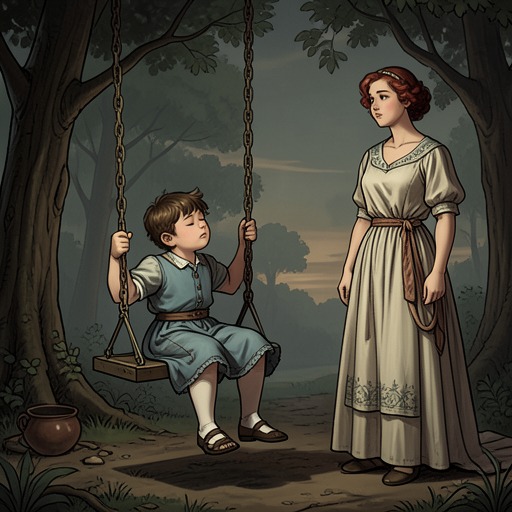
Miss Lavendar gives Paul a vivid account of her companion. The boy has blue eyes and curly hair, steals in to wake her with a kiss each morning, and spends the day playing with her in the garden. They run races, talk with the echoes, and share stories. Her description grants the dream boy a repeated place in the ordinary rhythms of a day, from morning through twilight, rather than confining him to a single story or moment.
The most intimate part of the account is the scene Paul completes for her. Miss Lavendar begins to describe what happens when twilight comes; Paul eagerly imagines the boy sitting beside her, too old at twelve to climb into her lap, resting his head on her shoulder while she holds him close. Miss Lavendar confirms that Paul has understood her, and the narrator finds the two together when Anne comes out of the stone house. This moment shows the dream boy’s emotional reality within Miss Lavendar’s life without claiming that he exists outside her imagination. Paul’s imagined continuation fits the tenderness of her account, and her response confirms their shared understanding.
Paul, Anne, and Conflicting Ideas of Thought
Paul’s ability to recognize Miss Lavendar’s dream boy belongs to a wider imaginative life. He tells her that he and Anne have dream-people, while his grandmother, Mrs. Irving, does not, and Mary Joe thinks he is wrong in the upper story for having them. The difference is not resolved by proving the dream-people real. Instead, Paul insists that having them is splendid, and asks Miss Lavendar to tell him about hers. His attention turns a private fancy into something that can be spoken of and received without ridicule.
Elsewhere in the same conversation, Paul describes a conflict over what kinds of thought are permissible on Sunday. Mrs. Irving disapproves of his talking to his rock people that day and teaches that Sunday thoughts should be religious. Anne has told him that every truly beautiful thought is religious, whatever its subject or the day. Paul agrees with Anne inwardly, but hesitates because his grandmother raised his father successfully and Anne has not yet raised anyone to adulthood. Anne acknowledges the force of experience and says they will have to wait to see how the twins turn out before judging whether her way is equally good. This exchange places imaginative thought within a household argument about guidance and religious propriety; it does not establish that the rock people are the same as dream-people. Paul’s imagination is part of the broader question of whether inward life should be restricted or trusted.
Recognition, Affection, and Narrative Significance
The conversation gives imaginative companionship a relational function. Paul does more than listen politely: he supplies the physical details of Miss Lavendar’s twilight scene and understands why her boy must remain young. Miss Lavendar, in turn, speaks openly about a dream she might otherwise keep private. The scene’s reciprocity matters. An adult’s imagination is not treated as childish merely because it is imagined, and a child’s account of inner life is not dismissed as foolish. Their conversation allows both to occupy the same imaginative ground.
Anne’s presence makes that ground broader than the pair alone. Paul explicitly includes her among the people with dream-people, linking his teacher to the recognition he feels with Miss Lavendar. In a nearby conversation, Miss Lavendar says she will miss Anne when she goes away in the fall and fears the hurt left when friends leave one’s life. The book does not say that the dream boy is a response to this fear, but the juxtaposition places imagined companionship beside the possibility of separation. The boy remains with Miss Lavendar in the garden, in the daily scenes she describes, and at the age she chooses; the dream gives her a continuing companion, while the conversation makes that private attachment visible to someone who understands it.